Wall Street Flat as Investors Await Jackson Hole
Tuesday 19 August 2025

The UK and EU announced a groundbreaking deal after meeting in London on Monday, 19 May. This is the first landmark agreement since Brexit in 2020.
UK gilt yields surged on the news announcement, with the UK’s FTSE 100 (UK 100) and the EU’s Stoxx 600 (FXXP), CAC 40 (FCE), and DAX (FDAX) all coming under pressure in the wake of the deal. The host estimated that the post-Brexit agreement could add £9 billion per year to the UK’s economy by 2040.
The UK-EU reset deal is the UK's third major deal over the past few months behind the US and India, which are “good for jobs, good for bills and good for [the UK’s] borders”, especially with the EU being the top trading partner.
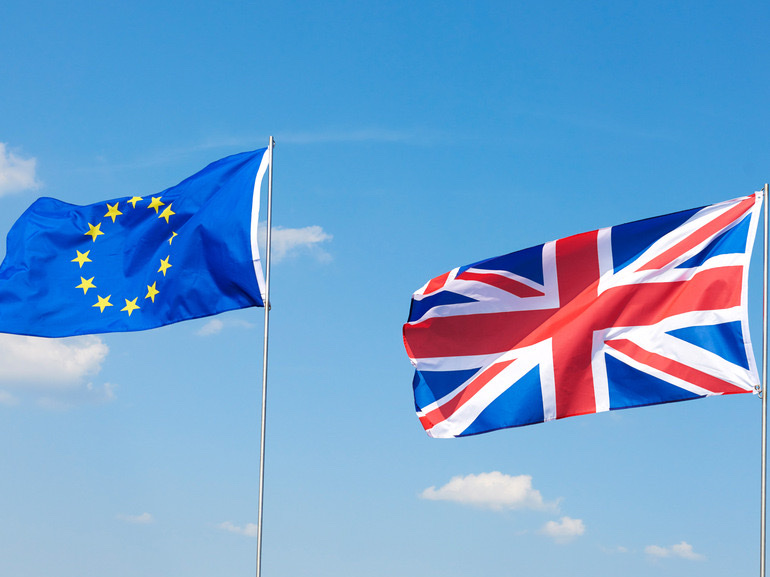
After six months of sweeping talks and five years of the European Union without the UK, the two sides settled on travel, defence, fishing rights, carbon tax, and food and drink sales.
Travel: British travellers (and their pets) will be able to cross borders again using the EU e-gates after the roll-out of the digital border checks in October
Defence: The two sides agreed to establish a defence and security pact, with the UK joining a military mobility project – PESCO – and accessing a £150 billion EU fund – Safe – for defence loans
Fishing: The UK granted 12 more years of access to UK waters on a licence, with the UK maintaining its 25% fishing quotas (to be agreed annually) and investing £360 million to boost exports
Farming: Animal and plant trade checks at the border will be dropped – a big win –, though the UK is expected to follow EU sanitary and phytosanitary (SPS) rules
Carbon: The two carbon markets will connect to avoid carbon taxes on items travelling between the two sides, such as steel and cement. This will save the UK £800 million, and steel alone will save the UK £25 million.
Aside from the agreed items, the two sides also agreed to extend talks on a free pass for the youth, an Erasmus programme, facial recognition technology for catching criminals, tackling migration and participation in the EU’s electricity market.
However, some Scottish officials have expressed disappointment with the UK’s decision to extend the EU's fishing rights to 2038, accusing the government of sidelining the country after it cancelled three ministerial meetings.
The “reset” agreement between the UK and the EU comes at a time of uncertainty in global affairs. Both sides seek to ensure safety and security amid the war in Ukraine and the recent shift toward US protectionism. Since his inauguration, US President Donald Trump has pushed NATO allies to spend more on defence while refusing to condemn Russian President Vladimir Putin, which has brought EU countries closer together. (Source: Fox News)
Meanwhile, the UK and the US announced a lower tariff agreement in early May, including deals on autos, steel, and agricultural products. This was the first major deal between the US and large trading partners. Despite tariffs remaining, they were set at a lower 10% rate instead of the 20% that other US partners, including the EU, face from 8 July. The EU pledged to analyse the lower levy and the entire UK–US deal at the time.
The back-to-back deal rounded off the third trade agreement in May for the UK, with India signing an agreement early in the month, removing taxes on 90% of British products that sell in India. All three deals support Starmer’s post-election stance to reset and preserve relationships. Notably, the EU deal will add a mere 0.2% to the UK’s GDP by 2040 at a time when Brexit exports to the EU are down 21% and imports are down 7%. However, it also comes as the Prime Minister’s popularity tumbled to 23%, a record low, while Reform leader, Nigel Farage, has received further support, according to YouGov data.
The deal's announcement was taken positively by markets on Monday, seen as increasing economic prospects, with both short- and long-term gilt yields rising. However, some analysts argue that UK gilt yields were up on Monday due to a weaker dollar (DX) in the aftermath of Moody’s (MCO) US credit rating downgrade. In fact, the deal was a positive step in rebuilding economic relations with the EU after the UK left the bloc, but it was not a game-changer given its mere impact on the UK’s GDP and the tax-neutral nature.
However, further talks may impact UK growth, with the economic benefits depending on the fiscal headroom it allows the UK government. As a reminder, back in March, UK gilt yields rose to multi-decade highs due to concerns about the rising borrowing costs, which were laid out in the Budget plan details. Nonetheless, the rise stemmed from a sell-off in UK bonds due to investors losing confidence in the UK government’s ability to service its debt.
Bank of England (BOE)Governor Andrew Bailey argued that the UK should rebuild its ties with the EU in early May after the central bank cuts its interest rate and the landmark deal with the US. The bank has also noted that a trade war with the US would have trimmed 0.3% off the UK’s GDP until 2028, and decided to raise its GDP growth forecast for 2025 to 1% from 0.75%, but reduced its inflation projections. However, the chances of a June rate cut have been reduced to 5 basis points from 15 basis points before. Notably, the shorter-term UK CPI print, due on Wednesday, 21 May, is expected to surge to 3.3% from 2.6% year-on-year.
The UK-EU “reset” deal represents a landmark agreement post-Brexit, but while gilt yields rose following the announcement, the expected 0.2% GDP boost by 2040 suggests traders may take expectations with a pinch of salt.
Despite the agreement completing the UK's trifecta of recent deals (alongside the US and India), it occurs amid challenging conditions at home. Starmer's popularity is 23%, and Brexit has already reduced EU exports by 21%.
For forex traders, the deal provided moderate sterling support. Still, it may be viewed alongside upcoming UK inflation data and how the BOE rate expectations may evolve rather than as a standalone market catalyst.
*Past performance does not guarantee future results





Learn insights through informative videos, webinars, articles, and guides with our comprehensive Trading Academy.
Discover what’s trending in and outside of Plus500.
This information is written by Plus500 Ltd. The information is provided for general purposes only, and does not take into account any personal circumstances or objectives. Before acting on this material, you should consider whether it is suitable for your particular circumstances and, if necessary, seek professional advice. No representation or warranty is given as to the accuracy or completeness of this information. It does not constitute financial, investment or other advice on which you can rely. Any references to past performance, historical returns, future projections, and statistical forecasts are no guarantee of future returns or future performance. Plus500 will not be held responsible for any use that may be made of this information and for any consequences that may result from such use. Hence, any person acting based on this information does so at their own discretion. The information has not been prepared in accordance with legal requirements designed to promote the independence of investment research.